How to Ride a Horse Like a Leader
-by Linda ParelliThis article was originally published in the April 2005 issue of Savvy Times magazine. Recent back-issues of Savvy Times are available for Parelli members in the Resources section of Parelli Connect.
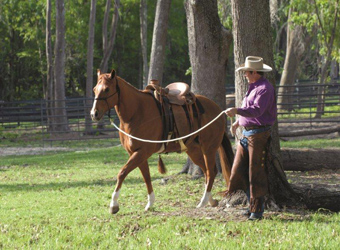
Taking leadership from the ground into the saddle is an important thing. You may become quite efficient at controlling your horse on the ground, but if you have a sensitive, unconfident, spooky or over-exuberant horse, you’ll need to understand some important principles in order to move forward successfully… and preserve your confidence.
Horses need leadership both on the ground and in the saddle. Leadership is essential to them in the wild; if they don’t have a leader they will become one and make all the decisions as to when to go, when to stay, and when to run. So if you don’t lead, they will.
Your leadership tends to be challenged in certain situations. When everything is calm and okay, everything is fine! But when a horse feels unconfident, scared, spooked or wants his own way there are some golden principles to observe.
WHEN IT COMES TO HORSE TRAINING … THINK LIKE A HORSE
In situations where your horse suddenly speeds up, overreacts, spooks – what do you think your horse is feeling? Fearful and unconfident horses are the most likely types to exhibit these behaviors, so pulling back on two reins actually worsens the problem because they feel trapped.When a horse gets scared his NUMBER ONE REACTION IS FLIGHT – RUN AWAY! They are not thinking and plotting, they are reacting! It’s all out of self-preservation – the instinct to survive.
When horses get scared, they are going to run. The more you hold them back, back them up, or try to stop them, the worse it gets because they NEED TO MOVE THEIR FEET. The only way to try to understand what they must be going through is to put it into perspective for yourself.
Imagine you are walking through a graveyard with a friend and there’s a sudden noise or image that scares the life out of you! Your instinct is to take off out of there as fast as you can, but just as you launch yourself your friend grabs you by the collar and holds you back. At that moment you’d probably believe it was a ghost and your fear would escalate into sheer terror.
Panic is not a logical thing. The adrenaline produced by fear kicks in well before you can rationalize what’s actually going on, because that takes a little time. This is what happens to your horse, and given the horse’s hyper perceptiveness to the environment, changes, movements and sounds, he is probably reacting to things you didn’t even notice.
So, think about it from the horse’s point of view and don’t blame him for being fearful. Commit to learning how to help your horse become more confident about himself and in your leadership, and therefore less reactive.
ONE REIN FOR CONTROL – IT DISENGAGES THE HINDQUARTERS
When you bend a horse’s head around it disengages the hindquarters, taking the power away. When you pull on two reins, it actually engages the hindquarters and adds power to whatever the horse is doing – positive or negative.
Worst of all, holding the reins with two hands automatically causes you to pull backward on them in almost any situation – when your horse spooks, when he surges forward or turns suddenly, when you lose your balance, when he’s not doing what you want, etc. You feel as though you’ve got control, but in reality, your horse gets progressively WORSE. Every time you prevent a horse from moving his feet he becomes more unconfident, more fearful and more reactive, so he keeps having horse problems.
When you pull back on two your horse feels trapped because you stop his feet and hold him back from moving, so the panic builds. When you pull on one rein you turn your horse into a tiny circle but he can keep his feet moving; the panic dissipates. Allowing those feet to move is the secret, but controlling where they move is equally as important! Don’t let them run off! Cause the feet to “run away” in a tiny circle with the Lateral Flexion rein in extreme situations. Use the hindquarter disengaging Indirect Rein in less threatening situations.
LATERAL FLEXION VERSUS INDIRECT REIN
Lateral Flexion is a neutral rein position. Its purpose is to stop the horse’s feet when the horse is ready to stop. It doesn’t force the feet to stop moving immediately, but it stops them from running off. Once the horse’s emotions start to come down, the feet will stop.The Indirect Rein stops the horse from running forward, but unlike Lateral Flexion it asks the horse’s hind feet to keep moving while the front feet virtually pivot. It’s an active rein. In both cases the horse crosses his hind legs as he moves and the constant turning triggers the left brain to become active. In other words, it gives the horse time to start thinking again.
The difference between the two is that one is control (Lateral Flexion) and the other is leadership (Indirect Rein). So the secret is when to use what!
WHEN TO USE LATERAL FLEXION, WHEN TO USE INDIRECT REIN
Use Lateral Flexion in situations where the horse wants to run, buck, rear – more serious situations. The goal is to save your life and your confidence by stopping the horse from taking off, but at the same time dissipating the panic in the horse. It also gives you the opportunity to jump off on the same side as your horse is bent which gets more dangerous to do as he gains momentum when running off!
I’ve become very good at this because the moment I feel the horse starting to run and I can’t bend him to a stop (because I’m riding bridleless), I’m off with the first out-of-control step. When you’re bending your horse to get control, think this: I don’t blame you; I know you need to move your feet, but let’s run off in this tight circle rather than for half a mile or more!
Use the Indirect Rein in situations of mild spook, when the horse gets a little high-headed or you feel his attention drift away from you. Simply reach down and turn him in circles, yielding the hindquarters for as many revolutions as it takes before your horse can do them calmly. I say this because the first turn or two (or more) could be a bit rushed. All the while think these thoughts: What I’m asking you is more important than what you think is scary.
WHEN RIDING AROUND, USE A CASUAL REIN
The Casual Rein is held in one hand, close to the mane, elbow somewhat straight. The reins are loose and you have the opportunity to quickly reach down with the other hand and bend your horse to control him with lateral flexion or hindquarter disengagement. The opposite is holding the reins close to your body or in two hands.
It’s a good idea to set yourself up for success, which means avoiding situations that would automatically cause you to do the wrong thing. The worst of these is holding the reins in two hands because it becomes an automatic reaction to pull back on both. It’s actually very hard to just take one rein.
Holding the reins in the Casual Rein position can be so difficult to do when you don’t feel safe, but you need to really ‘get’ that you are riding a prey animal and it’s not about you! In order for you to survive you have to help your prey animal survive; that’s your job as leader.
Most importantly, if you don’t feel safe using a Casual Rein position you shouldn’t be on your horse in this situation. Holding your horse with two reins is a sure sign of your distrust or lack of confidence in a certain situation, unless you’re doing it for backing up, going sideways, or for collection.
IF YOU CAN’T RIDE ON A LOOSE REIN, YOU SHOULDN’T BE RIDING
This is the hardest thing to recognize, especially the more your self-confidence builds! I’ve done it myself. I think that if I have shorter reins I can react more quickly. And maybe I can, but the underlying truth is that I really don’t trust my horse enough to give him full rein. So the ride is peppered with moments of tension and spooking and fits of exuberance like leaping in the air, and I just tolerate it because it’s “not that bad”. The
point is, if you think it’s no big deal or that you’re minimizing the
effect – you’re wrong. Unattended behaviors tend to worsen over time so
everything you do should be directed at getting things to be better.
So if your horse keeps spooking, keeps leaping in the air or bucking
even if not scared, you need to reevaluate what you’re doing.
The
point is, if you think it’s no big deal or that you’re minimizing the
effect – you’re wrong. Unattended behaviors tend to worsen over time so
everything you do should be directed at getting things to be better.
So if your horse keeps spooking, keeps leaping in the air or bucking
even if not scared, you need to reevaluate what you’re doing.Be committed to riding on a Casual Rein on trails, during FreeStyle riding exercises – actually it’s a good test in any situation because you can immediately tell when the situation is not safe. The moment you feel like shortening up the reins you have a decision to make: bend and disengage to a stop (Lateral Flexion), disengage the hindquarters but keep them moving, or get off and help your horse become left brain again using emergency ground skills (backward, sideways, obstacles, etc.).
What usually makes you feel like shortening the reins is the feeling of tension in your horse, so instead of trying to live through it, think about actually doing something to change your horse’s behavior. For example, as soon as your horse looks off at something or tenses up, do three or more hindquarter disengagements (Indirect Rein) and then move on. The secret is to do as many as it takes until you feel your horse relax his body and stop rushing or bracing through any part of it. Then you can turn his head loose and carry on, still being ready at any moment to reach down and repeat.
The worst thing you can do is ignore it and think everything will be okay. You might be fooled this time but in the days, weeks and months to come, things will get worse. You don’t want to wind up saying, “All of a sudden for no reason at all, my horse totally flipped out, turned into a scared maniac and now is afraid of everything!” These things build up in a horse. You need to know the early warning signs so you can deal with them and never have to go there!
TWO REINS FOR COMMUNICATION
Even when handling two reins, think about it as communication rather than control. For example, even when you are going sideways or backward, your reins need to move with the horse’s front feet. It’s a Fluidity principle: Whatever you want your horse to do, you need to do in your body first. Your horse’s front legs are your arms and hands. You need to have a little motion in them to indicate what you want your horse to do. The moment you use those reins for holding back an emotional horse, you’re in trouble.Learn to feel the tension and bracing in your horse. Look and feel for signs like the head going up, a tense jaw, working the bit, bracing of the ribs, quickening of step. At this moment, activate one rein and disengage your horse until you feel his body relax. Pet him and continue being ready at any time to deal with his emotions as they come up.
It’s so important to realize there are three parts to your horse: The mental, emotional and physical horse. No matter what you are doing, when the emotional horse surfaces, you have to deal with that. Forget everything else and take care of it. If you don’t, it will come back to haunt you.
DON’T WAIT FOR THE INFERNO; DEAL WITH THE SPARK
Do less sooner so you don’t have to do more later. It’s much easier
to put out a spark than to deal with a wall of flames. The MOMENT you
feel your horse get tense DO SOMETHING. If all you did was simply
disengage him, moving his hindquarters until you felt his attention
turn to you instead of whatever he thought was the problem, you’d be
way ahead. Pretty soon your horse will get used to paying attention to
his leader all the time and that spooky or distracted behavior will
diminish.No matter how advanced you think you and your horse are, this is something you can never neglect. If that annoys you, get a calmer horse or get a motorbike! If you want all the pleasures horses can offer, you have to take responsibility for doing your part in the partnership.
HERE’S A PERSONAL EXAMPLE
When I first started the Parelli Method I rode for three months with one rein to break my habit of using two reins – that means I began most tasks with just one rein. You may not have go to that extreme, but I knew how strong my tendency was and I was committed to breaking that habit and really becoming the kind of rider my horse needed.The interesting thing is that when I reached higher levels and began playing with dressage concepts again, I rode with two reins too much and when Remmer spooked I made my collection/rhythm task more important than his feelings. Bad mistake! It took about two months for him to get my attention by spooking more and more regularly, and when he did it during one of our seminars, I finally woke up. He was usually so calm in front of audiences and “suddenly” he was looking into the crowds and freaking out. Oh boy, I ate humble pie big time.
I spent lots of time thinking about it and talking to Pat. What it boiled down to was that I made the pursuit of my goal more important than my horse’s feelings. The moral of the story is to take care of your horse’s feelings whenever they emerge, no matter what. They are more important than your goal, and they are more important than someone else’s opinion. If you take care of your horse’s mind, emotions, and body, he’ll give you everything you want… willingly.
